Trezor Login: A Complete 1200-Word Guide to Access Your Crypto Wallet Safely
Managing cryptocurrency safely begins with choosing the right tools—and for millions of users worldwide, Trezor is one of the most trusted names in hardware wallets. Trezor devices are built to store your private keys offline, away from hackers, malware, and online vulnerabilities.
To interact with your hardware wallet, you perform what is commonly referred to as the Trezor login. Unlike traditional logins that use emails and passwords, Trezor relies on physical device confirmation, PIN codes, and secure communication through Trezor Suite.
This guide explains everything you need to know about the Trezor login process: how it works, how to use it, how to troubleshoot issues, and how to keep your crypto safe.
Understanding How Trezor Login Works
The most important thing to understand is that Trezor does not operate like a typical online account. There is no cloud storage, no account profile, and no central server that you log into. Instead, the wallet is entirely self-custodial, meaning:
Your private keys are created and stored on your Trezor device
Trezor Suite simply acts as a management interface
The login process is a secure handshake between your device and the software
This ensures that only someone who physically has your Trezor and knows your PIN can access your wallet.
Why Trezor Uses a Physical Login Method
The Trezor login model is designed with security as its foundation. Hardware-based access solves many of the problems that online accounts face.
1. Maximum Resistance to Remote Attacks
Because the device needs to be physically connected, hackers cannot remotely access your wallet.
2. PIN Protection Shields Unauthorized Access
Incorrect PIN attempts slow down exponentially, making brute-force attacks impossible.
3. Private Keys Never Leave the Device
Even when logging in or signing transactions, your keys remain inside the secure chip.
4. Eliminates Password-Based Vulnerabilities
There are no passwords to steal, guess, leak, or reset.
5. Optional Passphrase Adds an Extra Layer
This creates a “hidden wallet” that only opens with your unique passphrase.
Together, these elements make Trezor login one of the most secure authentication methods available in crypto.
What You Need Before Logging Into Trezor
Before starting, make sure the following are ready:
Your Trezor hardware wallet (Model T or Model One)
A working USB cable
The official Trezor Suite app
Your PIN code
(Optional) Your passphrase if enabled
Your recovery seed stored somewhere safe (not used for login)
Once you have these items, you're ready to begin.
Step-By-Step Guide to the Trezor Login Process
Below is a detailed walkthrough of how to log in to Trezor Suite and access your wallet securely.
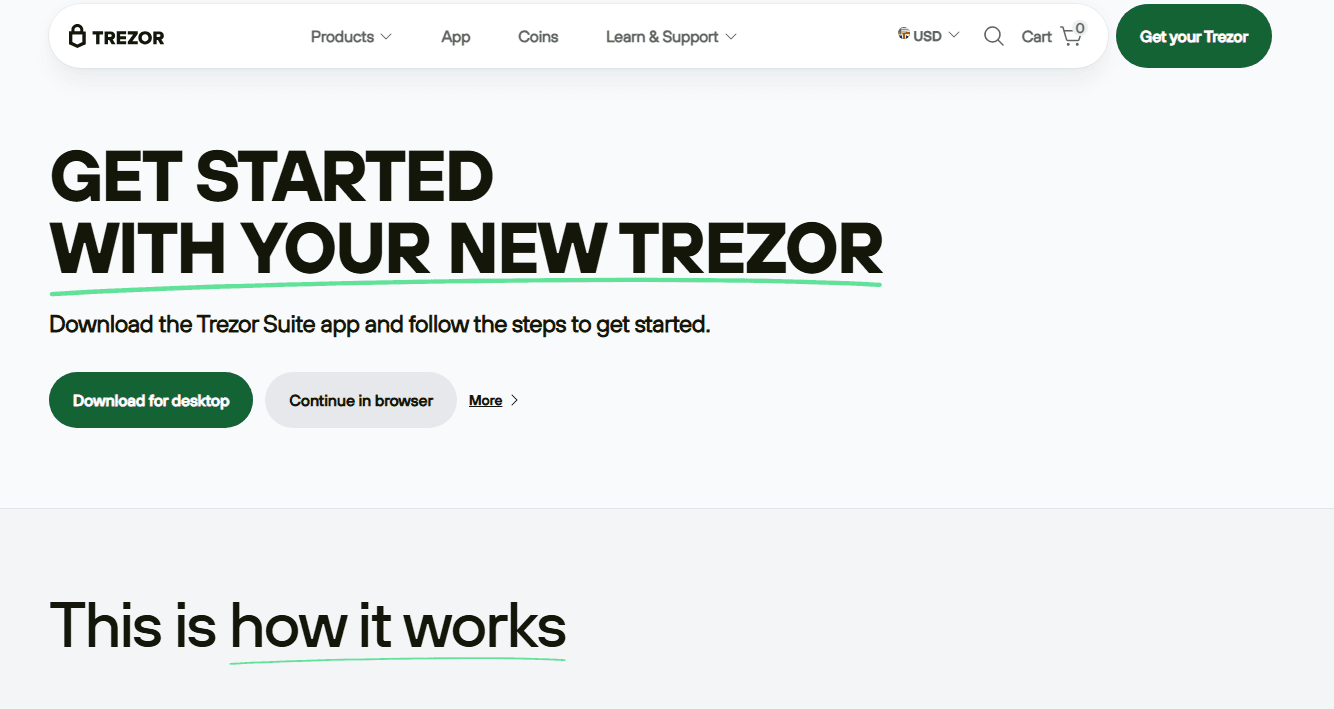
Step 1: Install and Open Trezor Suite
Head to the official Trezor website and download Trezor Suite for your operating system. It is available on:
macOS
Windows
Linux
There is also a browser-based version, but the desktop app is recommended for security reasons.
After installation, launch Trezor Suite. You will be greeted with the welcome screen prompting you to connect your device.
Step 2: Connect Your Trezor to Your Computer
Use the USB cable included with your device. Once connected:
Trezor Suite detects the device
Your Trezor powers on automatically
A prompt appears asking you to unlock your wallet
If your device does not appear, try switching USB ports or checking cable functionality.
Step 3: Enter Your PIN Using the Secure Keypad
When logging in, Trezor displays a randomized PIN matrix on the device screen. In Trezor Suite, you see a blank grid with nine positions. To enter your PIN:
Look at the number placement on your Trezor screen
Match those positions inside Trezor Suite
Click the correct squares to input your PIN
Because the numbers are hidden on the computer screen, keyloggers cannot capture your PIN.
If you enter the wrong PIN several times, the wait time between attempts increases dramatically. Too many failed attempts will erase the device—a built-in protection feature.
Step 4: Provide Your Passphrase (If Enabled)
A passphrase acts as an advanced layer of wallet protection. Unlike the PIN, the passphrase:
Is entered in Trezor Suite
Can be any length
Is case-sensitive
Opens a unique hidden wallet
Each different passphrase generates a different wallet, so you must type it precisely as originally created.
Users who want maximum security often enable the passphrase feature.
Step 5: Access Your Dashboard in Trezor Suite
Once logged in, the Trezor Suite dashboard displays:
Your portfolio
Market values
All crypto accounts
Token lists
Recent transactions
Buy, exchange, and sell options
From this interface, you can manage your balances, verify transactions, send crypto, and organize your assets.
Why the Trezor Login Process Is Exceptionally Secure
Trezor’s login system is built on multiple layers of protection, making unauthorized access extremely unlikely. Here’s why:
1. Two-Factor Authentication Built-In by Design
Unlike online platforms that require 2FA apps, Trezor naturally incorporates two factors:
Something you have: the hardware wallet
Something you know: your PIN
Both are required to log in.
2. The PIN Matrix Prevents PIN Theft
Since the PIN numbers appear only on your device, malicious software on your computer cannot capture your login code.
3. No Email or Cloud Account Exists to Hack
If a website doesn’t store your information, there’s nothing for hackers to steal. Trezor’s login is completely offline.
4. Recovery Seed Protects You Even in Device Loss
If your Trezor goes missing or becomes damaged:
The device alone is useless without the PIN
You can restore your wallet using your recovery seed
This makes physical theft significantly less dangerous.
5. Open-Source Code Ensures Transparency
The entire login process and wallet architecture are open for community review, enhancing trust and minimizing hidden risks.
Common Problems During Trezor Login & How to Solve Them
Even with a reliable system, issues can arise. Here are the most frequent login challenges and their fixes.
Problem 1: Trezor Suite Doesn’t Detect the Device
Try these solutions:
Use a different USB port
Use a new cable
Restart Trezor Suite
Reboot your computer
Update Trezor Bridge (if using the browser version)
Ensure antivirus software isn’t blocking the connection
Problem 2: Forgot or Incorrect PIN
If you cannot remember your PIN:
Continue entering attempts carefully
If you fail too many times, the device will reset
Once reset, use your recovery seed to restore the wallet
Your crypto remains safe as long as your seed is secure.
Problem 3: Passphrase Not Working
Common reasons:
Misspelled phrase
Incorrect capitalization
Extra spaces or missing characters
Since each passphrase opens a unique wallet, even minor mistakes change the result.
Problem 4: Trezor Suite Freezes or Crashes
Fixes include:
Updating to the latest Trezor Suite version
Reinstalling the software
Clearing the desktop app cache
Checking for OS updates
Problem 5: Browser Login Issues (Suite Web)
If you use the web version:
Install/update Trezor Bridge
Allow USB permissions
Try Chrome or Firefox
Disable conflicting extensions
Best Practices for Safe Trezor Login
Even though Trezor is highly secure, good habits protect your wallet further. Always follow these practices:
1. Keep Your Recovery Seed Offline
Write it on paper or metal, and store it somewhere safe and private. Never:
Photograph it
Upload it
Store it in email or cloud storage
2. Never Share Your PIN or Passphrase
No support team, website, or individual should ever request your PIN or passphrase. If someone asks, it’s a scam.
3. Update Firmware & Trezor Suite Regularly
Updates strengthen device security and improve performance.
4. Disable Browser Extensions You Don’t Trust
Extensions can interfere with Trezor Suite or cause login issues.
5. Protect Your Device Physically
Treat your Trezor like a valuable asset. Losing the device isn’t dangerous if your PIN and seed are secure, but keeping it safe is still smart.
Final Thoughts on the Trezor Login Process
The Trezor login system is designed to provide maximum protection with minimal complexity. By requiring physical device confirmation, PIN authentication, and optional passphrase access, Trezor offers one of the most secure ways to interact with cryptocurrency.
Whether you're a beginner or an experienced crypto user, understanding how the Trezor login process works ensures that your digital assets remain safe, private, and completely under your control.